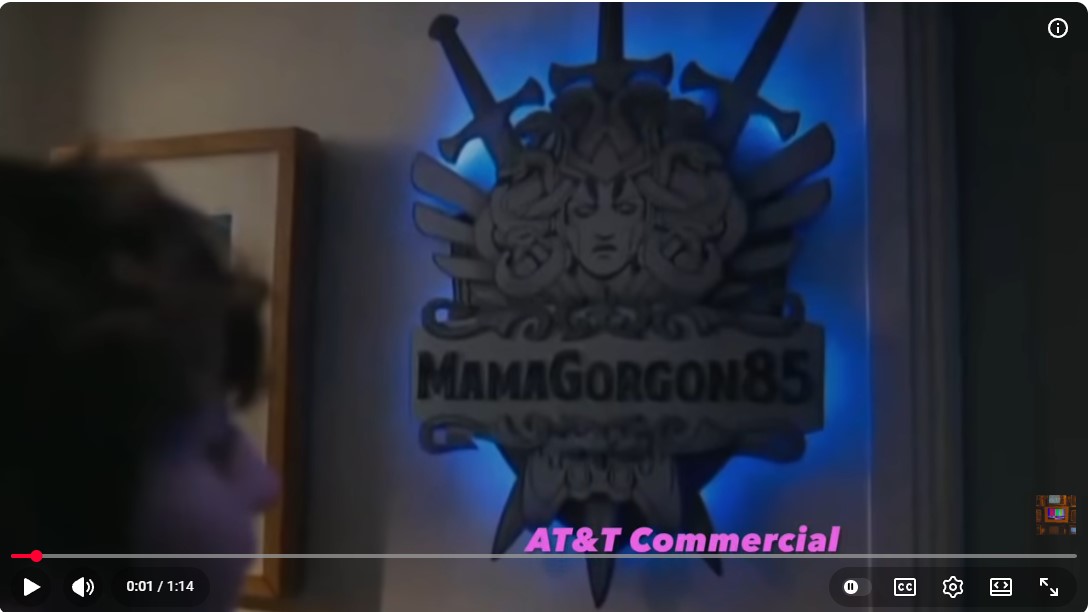
Pretty much whenever I watch a YouTube video at one point or another I get the MamaGorgon85 advertisement. I think it’s a terrible advertisement in that it isn’t effective. The point of an advertisement is to somehow convince the viewer to purchase the product or service.
I’m not going to get into a long discussion of how advertising works or why. Today I just want to examine why this particular advertisement, which is apparently considered good because of the frequent occurrences I must suffer through, is, in fact terrible.
MamaGoron85 Content
The content of the advertisement is fairly simple. A group of boys enter a house of a friend and see a sign on the wall of a room that reads MamaGorgon85. The boys gasp in astonishment and ask the friend if MamaGorgon85 actually resides here.
The boy replies in the affirmative explaining that MamaGorgon85 is his mother. The other boys declare, in incredulous disbelief that this is the gamer tag of a ruthless gamer. Mom then comes into the scene bearing treats for the boys and hopes they enjoy their stay. The commercial ends with the boys, in wonder, declaring that she seems so nice in real life.
Why MamaGorgon85 Doesn’t Work
The reason it doesn’t work is fairly simple. When they see the sign, the boys go into a long description of her prowess as a gaming god. She’s the ruthless slayer who has no mercy for anyone and rules the gaming universe. This, in the writing business, is called exposition. It’s tell, not show and that’s why the commercial fails, at least in my opinion.
We don’t have any evidence to believe that the sweet woman with the tray of goodies is a gamer other than the fact one of the boys tells us this is the case. We don’t see her playing; we do see a triple-monitor gaming setup in her room but that’s it. No trophies, no voice altering software to disguise her true nature, no gaming awards, nothing to make us believe for even the slightest moment that mom is MamaGorgon85. Even the fact that her son hasn’t disclosed this information to his friends at some point ruins the believability of the scene.
It’s this reliance on telling rather than showing that ruins the commercial entirely. I imagine that most gamers rolled their eyes, as did I, at the stupidity of the assertion.
There must be a story, a story that we believe in order for a book, a movie, or even a commercial to be effective. There is no story here and that’s the problem. It’s just exposition with no backing.
MamaGorgon85 is a Good Idea
The unfortunate part of this is that as a concept, it’s pretty good. No one knows who lurks behind a gamer tag, it could be anyone. The idea that a group of boys might stumble upon a world-class gamer in an unexpected place has merit but you have to set the scene. You have to make me believe.
Perhaps one of the boys opens the door accidently and catches her playing, her voice altered, a championship match going on. Then the son closes the door quickly and silences them, it’s supposed to be a secret. Something along those lines. Then, later, she comes into the room with a tray of cookies as the boys stare at her with googly eyes and look back and forth at each other in wonder.
Conclusion
I’m not saying my idea is the only way to make the commercial work, I’m sure others can come up with alternate scenes, I’m just saying that by not following the relatively simple structure of good writing, a good idea is mangled.
Tom Liberman