Does AI Make Students Dumber?

Students Dumber

I just read a fascinating article about economics professor Robert Serrano from Brown University who claims the use of AI is making students dumber. The article is mainly about using AI as a cheating tool and doesn’t go too deeply into the idea of making students dumber but that’s what I’d like to examine today.

Not just the idea of making students dumber but the overall effect of AI in making us all dumber and, happy days, I’ll even get to throw in an old-timey science fiction reference.

What’s the Story?

Professor Serrano administered a take-home economic test in his Welfare Economics and Social Choice Theory course. The exam was take-home because of a traumatic shooting incident at Brown not long before. Serrano decided to give it as a take-home exam to reduce stress on the students after the tragedy.

He claims he made the test more difficult because the students were able to take the test at home. The scores on the completed exam were astronomically high, a 96% average with nearly half the class receiving a perfect score. This was a significant increase on previous exams on the same topics. Comparing ChatGPT answers to the same question returned a high correlation with the students’ answer.

Serrano became suspicious and he decided to give the final exam in-class and if the results were significantly worse, he would throw out the high-scores from the take-home exam and base the final grade on the final test.

Only 59 of the 86 students stuck around to take the final exam with the rest dropping the course or skipping the final. Of those 59, only three did as well or better than their original test. The average scored dropped from 96% to 48%. Yikes.

Are Students Dumber because of AI Use?

Now, it’s fairly clear the majority of the students used AI to cheat but the underlying question, the one I want to examine, is if the use of AI is creating dumber students. Imagine you could get good grades by cheating with an almost zero percent chance of being caught. I can hear your answer, you have integrity, you wouldn’t do such a thing.

I wrote a blog about cheating in professional sports and how even the best players in the game were pressured by others cheating and surpassing them. Imagine you’re a college student, your grades determine, to some degree, the job you get, the organizations to which you belong, your future. Your grades are worse than many of the other students, not because they are smarter, but simply because they are cheating and you cannot compete.

Has your answer to my question changed? I think in the majority of classrooms, in the circumstances students find themselves in today, cheating is the right answer, the only answer. If you are cheating, which I think a large percentage of students are doing now, you are not learning. You’re simply parroting the thinking machines. You are not necessarily becoming dumber, but you are failing to become smarter, and you are failing to learn how to learn.

Conclusion

The problems we are facing with cheating students today is only the beginning. Things are likely to get much worse. It will become more and more difficult to distinguish a moronic cheater from a brilliant student. The consequences of that are yet to be felt but it appears to be coming.

Professor Serrano is quite correct to be afraid for the future. I am also.

Tom Liberman

Chess Engine versus Chess AI Trainer

Chess AI Trainer

I’m a chess player and I thought the difference between a Chess Engine and a Chess AI trainer a useful topic of discussion. The difference between the two is stark and to some degree a frightening vision of our future as a technology dependent society.

What is a Chess Engine

A Chess Engine is computer software that makes chess moves. Chess Engines have been around for quite a number of years and Deep Blue’s defeat of the reigning world champion Garry Kasparov was a milestone moment in computing history.

Since then, Chess Engines have only gotten more advanced and most include an Endgame Tablebase. This is a database that knows the best move to make when the board contains seven pieces or fewer. Work continues to increase the number to eight but so far, the goal remains elusive.

In any case, the point is clear that Chess Engines are better at chess than the best human players in the world. There is no credible argument against this fact.

What is a Chess AI Trainer

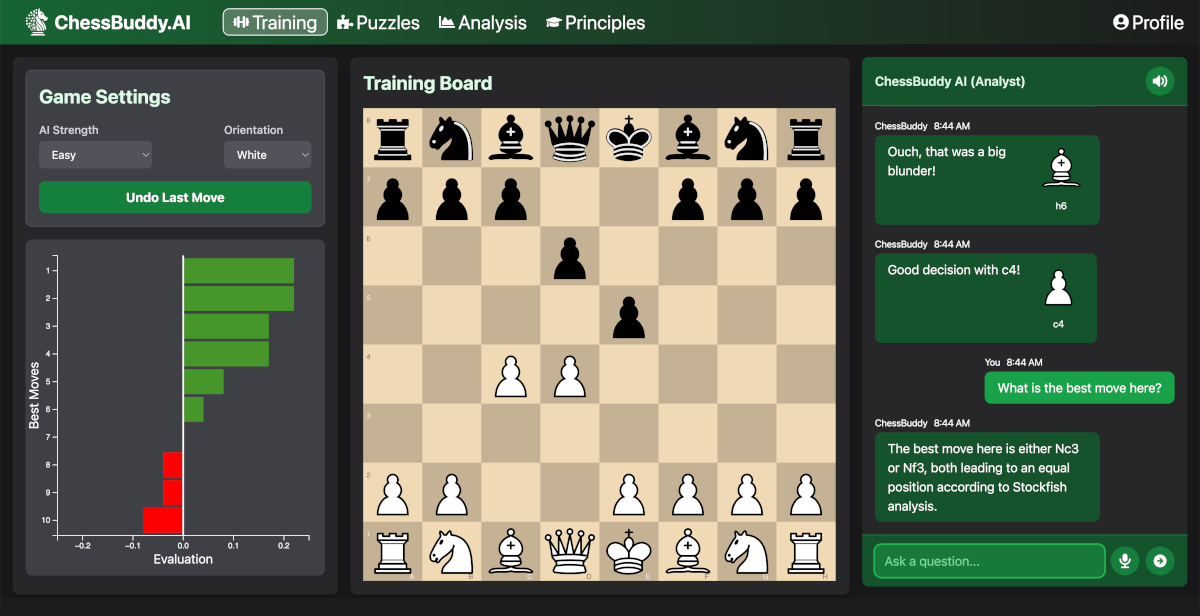
This is a more difficult question to answer but essentially it purports to be a tool by which you can improve your chess by asking questions of an AI entity. Why do I say purports? Basically, it doesn’t work. It’s largely useless. It gives generic platitudes like “control the center” and “threaten opponent pieces” although they often don’t make sense within the context of the question and are certainly things any chess video made by a human incorporates.

At best they do no more than a chess video or a chess book and at worst they give terrible advice. Even worse, this AI Slop can be self-training. One Chess AI Trainers provides content that the others “learn” from. Thus, they reinforce their own stupidity.

Why the Difference?

The difference between the effectiveness of the Chess Engine and the Chess AI Trainer is illustrative of why I’m not only skeptical of AI in general but seriously concerned that it presents a danger.

Chess itself is a relatively simple game. Sixty-four squares, two sides of balanced power, six different types of pieces, and stringent rules for how the pieces move and interact. Now, don’t get me wrong, it’s not a simple game. It’s incredibly difficult to master but it’s ideally suited to a computer because of this simplicity.

On the other hand, a Chess AI Trainer does not have a specific set of well-defined rules. Much like life. It can tell you that move A is better than move B and why but either in general and mostly useless terms or, if it has a Chess Engine running in the background, by spewing out a complex series of possible moves that is far beyond anyone but a top-tier player’s understanding.

My Frightening Conclusion

What’s the worst-case scenario here? That as AI proliferates, one tool trains the other tools into abject stupidity across the board. The enormous amount of slop that is spewed out overwhelms human endeavor.

We already see this happening. Product reviews, literature, artwork, feeds on social media. They are all overwhelmed by AI slop. What is real? It is generally not too difficult to discern AI slop from human created content but are we approaching a time when there is nothing but AI slop? There is no more reality? Decisions are made from nonsense?

Tom Liberman