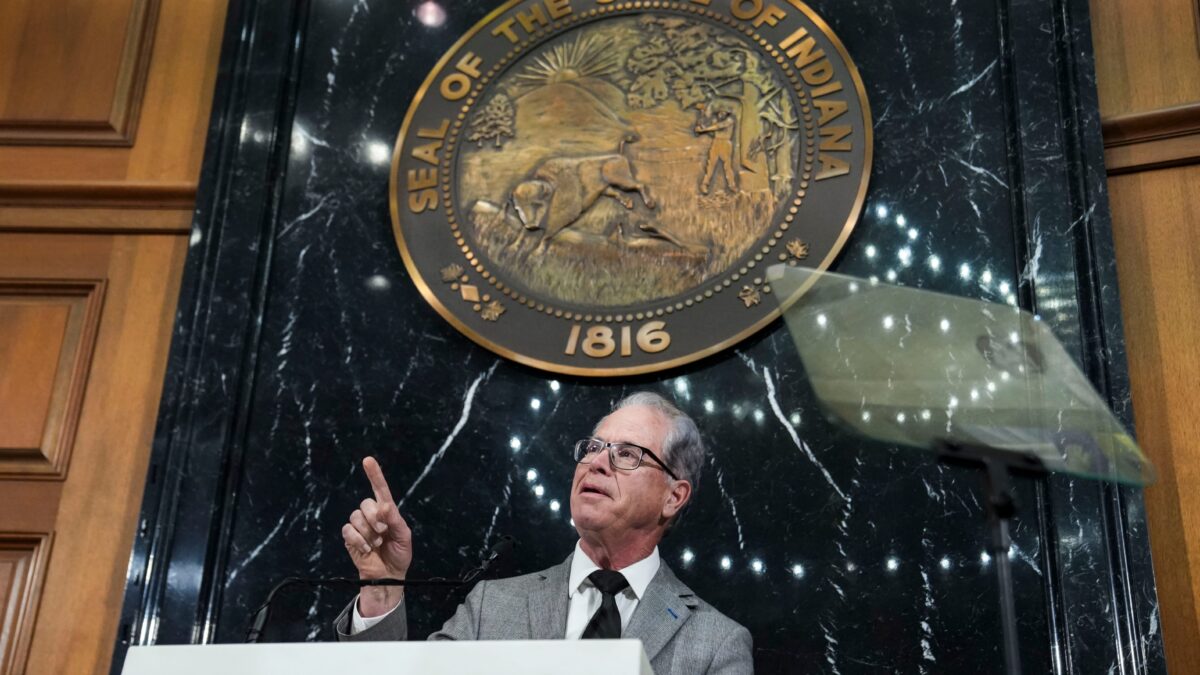
The Indiana Bears

Indiana Bears

There’s an interesting situation going on in Illinois involving the Chicago Bears football team and their desire to become the Indiana Bears. Well, that’s a misstatement but it makes my point. The chairman of the Bears, George H. McCaskey wants a new stadium.

The Bears are flirting with Indiana to get a new stadium in the Hoosier State as a bargaining chip with Chicago and the state of Illinois. It’s a corporate game that’s ruining our cities. Let me explain.

Tax Breaks for the Indiana Bears

Corporations don’t like paying taxes. Well, nobody likes paying taxes. I think we’re all in agreement on that. On the other hand, we do like roads, electrical service, plumbing, fire protection, law enforcement, and all the things taxes provide.

The Bears purchased some land back in 2021 with the hopes of building a new stadium at the location. The demand to stay in the region is they don’t pay property taxes. They want to negotiate payments instead of paying property taxes. We don’t know what they might negotiate but I think it’s fair to say the payments will be less than the amount of the yearly property taxes.

Who Pays Property Taxes if the Team Doesn’t?

Most everyone pays property taxes, except for all the businesses that negotiated their way out of paying them in order to build at a location. That’s the standard model now. Hey, city leaders, we’ll build this lovely factory in your city if you don’t make us pay property taxes or other taxes. You’ll get all those jobs, it’s a win-win.

It’s not a win-win, it’s a win-lose and you can probably guess who loses. Property taxes pay for all those government services I mentioned above and plenty of other things. The money for all those things is still going to get paid. Law enforcement alone at big stadiums like that is enormously expensive. If the Indiana Bears aren’t paying it, who is? The people of Indiana, that’s who.

That’s the problem with all the sweetheart deals corporations cut with municipalities to build. Someone still pays and it isn’t the corporations.

Believe me, I’m not a tax and spend lover. I’m all for keeping taxes in line with the service they provide instead of throwing it all into the general fund and letting politicians hand it out to their friends and family. I’m all for tax reform but I’m not for letting the Indiana Bears pay nothing while the people of Indiana pay for it all. Because that’s what the Bears are demanding and that’s what the politicians of Indiana are offering. That is, unless the politicians of Illinois throw up their arms and give the Bears what they want for the prestige of having an NFL team.

Conclusion

There was a time in this country when a business wanted to provide a good product or service, pay their employees a fair wage, make a decent profit, and be an upstanding member of their community. Those days are over. It’s all about foisting expenses onto the people and collecting as much revenue as possible.

Welcome to Greederica. I hope you enjoy your stay, sponsored by Brawndo.

Tom Liberman
Broken Social Contract – Who is to Blame?

Social Contract

The other day there was a thought-provoking opinion piece in the New York Times written by Thomas B. Edsall suggesting the social contract in the United States is broken. This is not a new idea in itself but he even-handedly looked at two possible causal effects for the phenomenon.

I’m going to first examine the idea of the Social Contract and what it means in the U.S. and then I’ll talk about Edsall’s article, the factors involved, and my ideas for real solutions.

What is the Social Contract

The idea behind the Social Contract is fairly straightforward and the Wiki article, as usual, does an excellent job of explaining it in great detail. Basically, people give authority to the government in exchange for the protection of their remaining rights. We The People allow our various government agencies, Federal, State, and Local to pass laws limiting our freedom but gain protection of our rights in exchange. Strange but, I think, true. As a very small example, the humble stop sign. It limits my ability to freely travel from hither to yon. Yet, this restriction actually allows me to travel freely with greater ease.

When everyone in a society recognizes the governmental limitations of the stop sign we are all better off. When people begin to ignore the stop sign then society begins to break down. If one person runs a stop sign then another person does the same. When everyone ignores stop signs the government loses the ability to enforce penalties for the violation and we apparently have more freedom in that we don’t have to stop at stop signs, but in reality we have less freedom because driving is significantly more difficult.

The Social Contract.

In the context of Edsall’s blog it references the perceived financial and ethical decay in the United States and the long-term implications to our country. The blog quite nicely summarizes two possible causes of the decay. One blames unrestrained greed while the other blames single parent households and the inability of people to hold down a job. I’ve over-simplified to a large degree but the idea is that as the Middle Class shrinks the ability to transition from disadvantaged to wealthy vanishes as well. This is bad for our country.

I spoke about this subject in a blog blaming stupid and unhealthy people. I don’t want to reiterate my points here.

On one side we blame unrestrained corporate greed. Corporations no longer care about contributing to the general community and that making money is the only goal. There is truth to this argument as stock prices, rather than a quality product at a reasonable price, is the main factor in business decisions. On the other side we blame fewer fathers, single mothers, and lack of education. Fathers are seen as a driving force in social cohesion. A single man with no children has no real need to coach the little league team, to improve the school, to fight for a stop sign at a dangerous intersection. That a single mother has a difficult time raising the child and doing any of those things. Stupid and unhealthy people cannot hold down a job and become a drain on society.

I think all those ideas have merit. I don’t think they are opposing ideologies. I think corporations, driven by unsustainable modern business practices, are less involved in making sure society is equitable, that there is reasonable chance to improve one’s station in life. I also think that single parent families face significant difficulties that dual parent households do not. That as jobs require greater mental ability, stupid people are left behind. All these contribute to the decline of the social contract.

The Underlying Issue

However, I think the underlying problem is none of these things. All of these things are products of the lack of objectivism in the people of this country. When we examine a thing for its true nature without bias and presupposition, we can make good decisions. It’s a bad decision to run a company to the detriment of the society that makes business possible. It’s a bad decision to have a child when you are not prepared to support that child. It’s a bad decision to not study in school.

We look to a bowl of ice cream for happiness. Immediate, tasty, and gratifying. Make money, have sex, eat until we have heart disease, knee problems, diabetes. We do not examine a situation and make decisions with a long-term goal in mind. Immediate gratification is winning over delayed and long-lasting gratification. We do the things that make us immediately happy and find, much to our surprise, that our lives are miserable. We do not think through the consequences of our actions. This is the problem and it is solved by teaching people to think.

Conclusions

The uneducated, unprepared, and greedy are not the problem, they are symptoms of the problem. The fact that a larger and larger percentage of our society is made up of these people is what is driving the decay. Until we teach people to think clearly, to make decisions that are in their long-term benefit, we will continue in our current spiral.

When a business leader makes a decision that will result in long-term benefit for that company it generally means long-term benefit to the employees, to the region, and to the nation. When a person makes decisions that will result in their long-term benefit it generally means those around that person will also flourish. When I succeed those who associate with me often succeed as well.

It is when we make decisions based on immediate gratification that we, and those around us, suffer.

As Marcus Aurelius said quite a bit more succinctly, That which is not good for the bee-hive, cannot be good for the bees.

Tom Liberman