The Road to Fanaticism

FanaticalToday I want to talk about how people become fanatical.

I do want to make it clear that I’m not talking about a light-hearted fanatic behavior. Perhaps someone is “fanatical” about a particular sports team or clothing designer. This use of the term has roots in aberrant fanatical behavior but there is an important distinction.

Someone who is passionate about a particular team or food or author is not to the point of killing someone who likes another team or food or author. Although, sports fanaticism can rise to the level of violence. I want to be clear that liking something passionately does not meet the criteria of fanaticism that I’m talking about here. Also, to be very clear, I’m not talking about religious people. It’s more than possible to be deeply religious and not be fanatical. Fanatics transcend the sport, religion, or other thing to which they profess their fanatic love. They are violent, they are unthinkingly loyal, they are certain that those who oppose them mean to destroy their way of life.

Finally, I also want to state that people who rise to violent fanaticism are not forced into it by any of the things I describe below. They, and they alone, are responsible for their actions. I think people who commit actions like this have brain damage of some kind. I just think, as I’ll talk about, that an environment that emboldens such maniacs can be limited through our own behavior and educational methods.

We see fanaticism currently in Anders Breivik who argues that his murder of seventy-seven children was self-defense because they represented a threat to his way of life.

This pathology shows us the means and methods of becoming a fanatic.

A fanatic is convinced that they must act to preserve their way of life. The way to achieve this conviction is to simply stop thinking about the possibility that you could be wrong. This is the very definition of Faith Based Thinking. I believe it is true and therefore it is. Without this, there is no fanaticism. So, how is that people can be convinced they need not look at evidence that doesn’t support their theory of the world?

Again, I don’t want to seem to be picking on religion in this post because, for once, I’m not. Fanatics transcend the religion they often, but not always, use to fuel their fury. They latch onto something and that something is often religion but it doesn’t make religion the villain. It comes from a mindset that looks at things in a very black and white fashion. I’m right, you’re wrong. There is no reason to consider your point of view, your feelings, your right to live.

So, how do we get people who think like this? How do we end up with fanatics who were “such nice, quiet boys” just a few weeks ago. Who are loving family members, good friends, contributors to society? People who “we could never imagine would do such a terrible thing?”

We fill them with faith-based ideas and more importantly fail to school them on critical thinking skills. That’s the road to fanaticism. All of you, my most religious friends, you don’t use faith-based thinking when it comes to the next big purchase. You use critical thinking. You don’t use faith-based thinking when it comes to an important work project, you use critical thinking skills. Everyone is capable of doing it but when we encourage people to ignore facts, to ignore science, to yell down those who disagree, to insult them, to attack them, then we teach fanaticism.

The talking heads on media are trying for ratings but are actually laying the foundation of fanaticism when they shout down and ridicule those with different opinions.

Again, don’t get me wrong. Even with encouragement most people don’t turn into fanatics. Most people maintain their critical thinking skills well enough to know not to kill a bunch of other people. But, the more we teach people to laugh at, ridicule, attack, and belittle those of opposing points of view the more we are fueling fanatics. Words like Repukicans, Libtards are vicious attacks against those we disagree with. You mean them as harmless verbal jousting but there are people out there who don’t see it that way.

I’m not blaming you. I’m not blaming me. Nut job fanatics have only themselves to blame but can’t we try rational discourse to set an example?

Next time someone espouses a position you disagree with try asking them this question: “What facts do you have to support that position?” And, here’s the crazy part, listen to their answer and think about it. Even if they don’t convince you at least you’re setting an example for those around you and I think we all know how important it is have good role-models.

The guy sitting next to you when you launch into a diatribe about how President Bush/Obama is destroying America might not be as rational as you imagine. They might not be a “nice, quiet guy”. They might find fear in your words. Fear of losing their way of life. This fear might embolden them to act.

So, I say stand up for critical thinking. Listen to the other side. Be a shining example to your family and friends. If everyone did that I suspect the world would be a better place and isn’t that the goal of any rational person?

Tom Liberman
Sword and Sorcery fantasy with a Libertarian Twist

Hammer of Fire – Book Cover Artist

I’m extremely happy to announce that Jesus Garcia Lopez has agreed to do the cover for my third novel, The Hammer of Fire. He did the amazing cover for my second book, The Staff of Sakatha and I’m eagerly awaiting his interpretation of the new work.

Beware those of you who follow the original link, some of his work is a little racy, nothing pornographic, more pin-up.

I finished the rewrite on the first quarter of the The Hammer of Fire and my stalwart proofreader, mom, is hard at work finding all my comma splices (and there are a lot of them). I anticipate having the finished work sometime next month depending on how fast things go.

The picture accompanying this post was done for me by Jenny Dolfen and depicts the protagonists of the new novel along with the titular weapon.

Thank you all for your great support,

Tom Liberman
Sword and Sorcery fantasy with a Libertarian Twist

Teaser – The Road to Fanaticism

FanaticalTomorrow I delve into the road the leads to fanaticism. A lot of things have to go wrong for someone to become a violent fanatic and it starts early. If you think about all the people in the world who could, with the flick of a wrist, turn their car into a crowded sidewalk and don’t it’s pretty amazing how few violent fanatics are out there.

If the path to being a fanatic is so well-known it seems we could take a few easy steps to stop it. I’ll try to cue you in on the warning signs and maybe you can stop someone heading down a dangerous path.

See you tomorrow!

Tom Liberman
Sword and Sorcery fantasy with a Libertarian Twist

Fanatics Week – Fanaticism

FanaticalI’m going to spend a week talking about fanaticism because the trial of the self-righteous murderer Anders Breivak is in the news. I’m not going to focus particularly on that case but on the nature of fanaticism and some of the psychological factors that play into it. I’m going to start off with a simple look at what fanaticism is and why it is so dangerous. And, believe it or not, I think my opinions here will be disputed by a great number of people. Read on and see for yourself.

Ok, back to fanaticism. Wikipedia defines it as a belief or behavior involving uncritical zeal, particularly for an extreme religious or political cause or in some cases sports, or with an obsessive enthusiasm for a pastime or hobby.

For those of you follow me regularly I hope you can see where I’m going to have a problem. Involving uncritical zeal. The key word being uncritical. The very nature of fanaticism is tied up in Faith Based Thinking with a complete absence of Critical Thinking. It’s important to understand that Faith Based Thinking is not merely the belief in god or some particular religion or another. It is a method of thinking that is dangerous.

I think that it is largely impossible to behave like Anders without faith-based thinking. It is impossible to become a fanatic without faith-based thinking. It is impossible to become a monster without faith-based thinking. It is this abandonment of critical thinking that leads to much ill. I’m certainly not saying that those who engage in faith-based thinking are destined to murder seventy-seven children on a camp retreat but I am saying, loudly and clearly, that those who abandon critical thinking and embrace faith-based thinking are going to make mistakes in every aspect of their lives.

Fanaticism largely stems from giving into your fears. When you fear something completely; you are willing to abandon reason and allow the violence that swirls beneath the surface to emerge. We all have that violence. It is important to understand the capability for humans for violence. I could, at any moment, kill my cat. I could easily grab a child around the neck and throttle him. I could push a pedestrian in front of a moving bus. We have that in us at all times and it is our reasoning, critical thinking skills, and rational fear for our own safety and well-being that keep us from doing it.

Here is where someone will say it is fear of eternal damnation or faith in god that keeps us from doing violent things. I disagree. If I behave violently, if I kill seventy-seven kids on their camp retreat, the odds are I will face terrible repercussions immediately. My freedom will be lost, my friends and family will abandon me. The only reason I can do such a thing is if I feel my situation is without hope, that I’ve given into fear and turned off all rational thought. fanaticism.

I’ll be doing a deeper examination of fanaticism, good and evil, and right and wrong as the week progresses but I think it’s important to understand that the root of this thing is the abandonment of reason and of critical thinking. While fanaticism might be born of fear and utter hopelessness it is driven to action by faith-based thinking.

Tell me what you think!

Tom Liberman
Sword and Sorcery fantasy with a Libertarian Twist
Emotional Intelligence

Social GracesAfter yesterday’s post summing up my conclusions on intelligence I got a comment asking my opinion on how I thought “Emotional Intelligence” factors into success. So that’s today’s topic. I admit a complete lack of knowledge on this subject but that isn’t going to stop me from telling you all about it!

A quick perusal of Wikipedia reveals the following definition: Emotional intelligence (EI) is the ability to identify, assess, and control the emotions of oneself, of others, and of groups.

I’m willing to get over my initial distaste at the combination of the words “Emotional” and “Intelligence”, as the two things are paradoxical in many respects, and try to break down the concept. It seems to me what is being said here is equivalent to social graces. People who are good at judging others’ emotions get along in social gatherings. They are good at “reading” what another person is feeling and are able to respond appropriately. As a card-carrying member of the Aspberger Team this is not exactly my forte but I can certainly recognize the trait in others.

This is supposedly testable using something called the Mayer-Salovey-Caruso Emotional Intelligence Test (MSCEIT … for short (insert eye roll here)). Event this admits it is testing against social norms. I don’t want to get into a big debate about testability. It is pretty clear that getting along socially is part of success in life, in answer to the original question.

So, if we say high intelligence leads to success are we not also bound to say that high emotional intelligence, or social graces, also tend to lead to success in life. My answer is … yes. Sadly.

Why sadly? I’ll tell you why. Because being good at social graces doesn’t mean you are good at achievement. People who are good at social graces get far in life. They convince people to trust them, they achieve positions of power, but they do not have the ability to actually achieve great things once they get there. There are exceptions, naturally. Some, rare, people have both high intelligence and high social graces. But, by and large what we are talking about here is The Monkeys or Milli Vanilli. Fake musicians who make millions of sales without doing anything other than being socially adept.

How many times have you lamented “politics” at work? This is someone using social graces to achieve promotion. Why do we call it “politics”? Because that is what politicians do. They get elected not on their actual qualifications but upon their ability to manipulate the emotions of voters.

Do I sound bitter? Maybe … well … probably. My social graces are next to nil. But, I think I make a valid point here. We want people who have the talents to get things accomplished in positions of power. Would you rather hire a charming plumber or a competent one?

I’ll wrap this up with a test question I’ve been asking for year. How you answer it is telling in this social intelligence versus intelligence debate.

Place in order your preferences for the checker in your lane at the grocery store:

  1. Friendly and Fast
  2. Friendly and Slow
  3. Surly and Fast
  4. Surly and Slow

My order is 3-1-4-2.

Yep, I prefer Surly. Why? Because I don’t want to have a conversation with the checker. It is rude to the people waiting in line and, frankly, I’d rather be at home analyzing my chess games and planning my next Dungeons and Dragons session.

In all seriousness, the issue isn’t black and white. Everyone has shades of Intelligence and Social Intelligence. But, I stand by my conclusions. I’d rather have competent people working with me than socially adept ones.

Tell me what you think!

Tom Liberman
Sword and Sorcery fantasy with a Libertarian Twist

Teaser – Emotional Intelligence

In response to my recent conclusions on intelligence one of my few followers asked me what I thought about “emotional intelligence”. I thought I’d take on this topic. Just to get you ready for my blog I’ll tell you right now that I’m not sure that “emotional intelligence” is actually a thing. I do think I understand the gist of the question which boils down to the concept of social skills as opposed to intelligence.

Anyway, it’s an interesting question and I’ll talk about it tomorrow!

See you then,

Tom Liberman
Sword and Sorcery fantasy with a Libertarian Twist
How to make More Intelligent People

IntelligenceI’ve been discussing intelligence all week long and now it’s time for my conclusions. Brace yourself because, as usual, I’m not out to make friends.

It is clear some people are more intelligent than other people and that intelligence plays an important role in the advancement of both individuals and societies. The Bell Curve speculates that government policies that allow poor people, who do less-well on IQ tests, to have more children has a negative effect on the average intelligence of the United States  and thus is detrimental to the health of the nation.

I have serious problems with almost all of the principles of both measuring intelligence by IQ tests and trying to determine, through government policy, the best way to breed for intelligence. IQ tests, it seems to me, are most certainly culturally biased. Immigrant groups will always do poorly but as they become amalgamated with the culture, or as the culture changes with immigration, they will drift towards median scores.

Blacks traditionally do poorly on IQ tests and I can tell you exactly why. Black culture largely associates education and success with being “white”. It has nothing to do with intelligence potentials. I went to a highly mixed race school. Far and away the most brutalized students were the “smart” black kids who took upper level courses with the white kids. They were assaulted for trying to be “white”. Many prominent blacks have pointed this out over the years and things will not change for blacks until they overcome this cultural belief.

A culture that values education will produce kids that score high on IQ tests. Bottom line. Perhaps there is something to be said for inheritable intelligence but this limits the potential ceiling of achievement. By this I mean that I can play offensive left tackle as an eight year old for my block football team but I cannot play that position for the St. Louis Rams because I am limited in my ceiling by my physical stature. Everyone, with the exception of the mentally handicapped, is capable of thinking at a reasonable level and scoring reasonably well on IQ tests. So, in all practical terms intelligence has nothing to do with wealth, race, creed, or anything else. If parents and community value education and intelligence then the results will follow.

I absolutely agree that intelligence, or high IQ, is a predictor of success. Success is good. We want people who achieve. The more people who achieve the better for society. I don’t really much care about whether high IQ scores are exact predictors of intelligence or not. They are close enough I suppose but it doesn’t matter. If you are intelligent you will likely do better in life. If we threw IQ tests away we’d still have intelligent people, just not a snobby way to quantify them.

So, that’s the bottom line. We want intelligent people. We want to encourage all people of all cultures to value education so they will get good jobs, produce, achieve, elevate society. How do we do it? Reward achievers! That’s Ayn Rand, that’s Objectivism, that’s Critical Thinking. That is everything I talk about in this blog.

There’s nothing wrong with making sure our schools have the best equipment, that our teachers have all the aids necessary to be great, to encourage parents to be a part of their child’s schooling process, and to find the best ways that people learn and implement those methods. I’m all for those things.

The thing we can’t do, and this is where I’m in partial agreement with The Bell Curve, is reward stupidity. There should be a safety net. There are disabled people, mentally retarded people, people who fall on hard times, and we do not want to become a nation where those sorts of people are discarded and brutalized. But, we can’t continue to reward failure.

When it comes to wanting to stop rewarding failure so-called Conservatives seem to focus on the poor, and I agree that changes must be made with welfare, but the reality is that far and away most rewards to stupidity go to business. Our failed politicians, Democrat and Republican, still rake in massive amounts of bribes, er campaign contributions, in the hopes that they will pass laws to give one business an unfair advantage or bail-out yet another round of failed enterprises. Stop the madness!

Government get out of the tax-break business and social engineering. It leads to failure. Let good business succeed on its merits, let educated people succeed because of their intelligence.

And parents, most of all, take a hard-core, hard-line, day-to-day interest in your child’s education. Smart is good. Dumb is bad. And I’ll stand by that until the day I die.

Tell me what you think in the comments and share if you feel like it!

Tom Liberman
Sword and Sorcery fantasy with a Libertarian Twist
Teaser – Conclusions about Intelligence

Tomorrow I wrap up Intelligence week with my conclusions. It’s a complex topic and I don’t think that I’ll have the final say in the matter but there are some important issues that need clarification. Are IQ tests accurate? Is intelligence inherited from one generation to the next? Is it important for the government, through policy, to discourage lower IQ people from having children? These are major issues that have an impact on the future of the nation and the world.

So, come back tomorrow to see what I think!

Tom Liberman
Sword and Sorcery fantasy with a Libertarian Twist
The Bell Curve

The Bell CurveThe Bell Curve was a novel written by a Libertarian in 1994 that took an analytical look at intelligence using IQ testing as the backbone for its conclusion. To say it was highly controversial is to accurately portray its reception. In addition to libertarian Charles Murray it was co-authored by Richard J. Herrnstein a professor at Harvard.

The book argues that intelligence is primarily a product of genetic inheritance (40% to 80%) and secondarily to environmental factors and an excellent predictor of success in life at almost every level. It based the results on IQ scores of large groups of people and their eventual outcomes in life. It looked at education, criminality, age at which children were born, salary, and other life defining issues.

The reason it generated so much controversy is that it suggested that inheritance of intelligence played the predominant predictive factor although it stops well short of suggesting this is the only factor. It also points to the undeniable difference in IQ scores with whites and Asians scoring significantly higher than other races.

The recommendations from the book included ending most welfare programs, ending affirmative action, and reducing immigration. It couched most of these recommendations in the idea that poor people have bad IQ scores and yield children with the same issue. Also, that the poor tend to have far more children than the wealthy and this imbalance has the effect of making the United States less intelligent as a whole. It generally spoke in terms if income not race but the implication is undeniable.

It predicted a stratification in society wherein the middle class would diminish and the gap between the wealthy and the poverty ridden would mirror that which we see in poor Latin American countries. Thus the wealthy whites and Asians would live in fenced communities protected from the poor masses of other races. It predicted the conservative movement would be subverted into a philosophy that focused on doing anything to preserve its wealth and an eventual turn of government towards totalitarianism.

Dire predictions indeed.

There are a number of criticisms of the book in particular as to its assignment of IQ test results as the primary source of its base assertion of intelligence. I’m not going to get into them all here but I’ll talk about a few before I wrap it up.

Many criticize the idea that intelligence can be summed up in a single number, the IQ test result. They claim intelligence is much more complex than this. The manipulation of the final IQ score through the g-factor is relatively arbitrary and when scored as it was on the test overstates the difference in IQ between races. A number of follow-up studies using the same methodology have produced less dramatic results in scoring gap between races.

Many point out that immigrants of all nationalities, Jewish, Irish, Italian, etc. have traditionally done poorly on Intelligence Tests and that as they amalgamated with society saw dramatic increases. This would seem to indicate a bias in the IQ test towards the culture of the people giving the test and argue against the immigration policies suggest by the book.

Charles Murray  answered many of these criticisms with a follow-up of the book using siblings for his study. The siblings he used were chosen because of a wide divergence in their IQ scores. He then analyzed the life accomplishments of the high scorer with those of the low scorer. The results of this test validated the original test although the gap in accomplishments was somewhat narrower than the original.

I’m going to save my conclusions of IQ tests and intelligence as a whole until tomorrow but I will state that there is a great deal of validity to the idea that smarter people do better in life. That the higher the ratio of smart people to stupid people we have in the United States the more likely it is our country will prosper. I am skeptical of IQ testing as an absolute measure of real intelligence and I’m also skeptical of racial causality of gaps in intelligence testing scores. I’ll get more into those topics when I conclude tomorrow.

Today I hope that I gave you some insight into an interesting book that, at its base, was trying to formulate policies that would increase the average intelligence of people in our country. That’s a worthy goal.

Tell me what you think about this controversial subject in the comments and share away!

Tom Liberman
Sword and Sorcery fantasy with a  Libertarian Twist
Teaser – The Bell Curve

One of the most controversial books published on the subject of intelligence and its practical applications is called The Bell Curve. It was written by Libertarians and made some bold predictions about the future of the United States. Tomorrow, in the next chapter of my Intelligence Week, I’m going to take a look at that book and some of its predictions. I’m also going to examine some of the ideas that it promulgates and how they apply to the country and to the world.

It should be fun!

Tom Liberman
Sword and Sorcery fantasy with a Libertarian Twist
Artificial Intelligence

Artificial Intelligence

Artificial IntelligenceToday Intelligence Week takes a turn towards science fiction as I examine the concept of Artificial Intelligence. I’ve spoken about IQ test and trying to define intelligence, now it’s time to determine if computer intelligence is already or will someday soon surpass that of humans.

By many units of measurement computers are already far, far smarter than humans. Their biggest advantage is speed in information retrieval and their biggest disadvantage is in perception using senses.

One of the things I find interesting is the difference in definitions for human intelligence and computer intelligence. The same standards do not apply. I wonder how a computer would do on an IQ exam?

Still, I understand the differences. When measuring intelligence in a human we are working with a subject that we define as intelligent. All humans have reasoning abilities of one sort or another (hold the jokes) whereas with computers we are trying to determine if one can be created that thinks, for lack of a better term, like a human.

The definition of computer intelligence has been fairly well standardized in a series of problems to be overcome. The list is too lengthy and complex to cover here but it boils down to making computers accomplish tasks that humans can do with ease. Things like planning, learning, using social skills, and creativity.

Progress has been made on many fronts but I’ll give two quick examples. A computer answering machine named Watson recently won a Jeopardy competition over top-level human foes. This represents an important step-forward in artificial intelligence. Another example is that, since the victory in 1997 by Deep Blue, chess computers are better players than the strongest human.

The Jeopardy victory in particular is interesting because it shows that computers are now capable of acting as Help Desk attendants in much the same way as the Computer on Star Trek helps the crew members. Imagine a superfast machine with access to an immense database on the other side of the phone instead of today’s automated system or a person reading from a script. This is something to welcome, not fear, although I know I’ll have a hard time convincing people of this argument.

It seems inevitable to me whether or not a computer actually achieves “artificial intelligence” their role in our lives is going to increase dramatically. And that’s how I want to wrap up this post, with some thoughts about what computer intelligence means for us in the near future.

Intelligence in computers mated with advances in robotics, a topic I’d like to take on soon, is well on the way to changing our lives. Robotic helpers with access to huge amounts of information will soon, I think, greet us on the phone, over the counter, when we arrive home, at school, and at work. Computer algorithms already help us tremendously every day if you think about our use of search engines.

The concept of computer intelligence is summed up in an idea called a Technological Singularity. There are many promises and dangers in this concept but i don’t want to spend too much time it today. Suffice it to say that computers are getting smarter and will continue to take a more active role in our lives, for good and for ill.

I guess that’s my final conclusion. It doesn’t really matter if a computer achieves the title of “Artificial Intelligence” or not. We are going to continue to improve computers and they will continue to play ever more important roles in our lives. The definition of intelligent doesn’t really change the fact of the matter. If the Cylons or Berserkers are the result or if R. Daneel Olivaw is the result, well, that’s where we are headed.

Tom Liberman
Sword and Sorcery fantasy with a Libertarian Twist

Teaser – Artificial Intelligence

Tomorrow Intelligence Week continues when I take a look at the state of Artificial Intelligence development. It’s tough to define intelligence and not so easy to quantify it either but there is still a chance we can build it. I’ll talk about where we are now, with some chess references of course, and what the future might entail as developments continue.

It’s some exciting stuff,

See you tomorrow!

Tom Liberman
Sword and Sorcery fantasy with a Libertarian Twist

What is Smart?

IntelligenceNormally I start a week-long topic with the definition of said idea but I went a little backwards yesterday because the concept of being intelligent is so difficult to define. IQ tests have become a defacto measurement and they might well represent the greatest probability of measuring intelligence. Today I’ll look at some of the ideas about what defines intelligence and tell you what I think are its most important indicators.

Let me start by admitting that I’m not going to find a unifying answer but I do have my definition. It’s a brutally difficult to define intelligence and more than one brilliant mind has tried to answer the question but there is no consensus. That being said let’s take a look at the kinds of intelligence to be found.

One main theory that has, I think, some excellent points is called the Cattell-Horn-Carroll theory. It suggests there are a number of interrelated factors in intelligence. The list is lengthy, I’ll let you read the article if you desire, and I’ll just summarize here. Intelligence seems to include reading/writing skills, processing information with your senses, numeric understanding, memory, reasoning faculties, and speed of processing.

So, in order to have intelligence we must be able to understand information, store it in memory for retrieval, categorize it, and decipher different pieces of information in a short period of time. Basically you must learn of something and store it away for later, usually an ability to categorize items is helpful for quick retrieval, and then when given other, related information, connect the two pieces into a final conclusion.

This is an extraordinarily simplistic definition but it will have to do. The ability to do the above is something I call mental agility. One thing to consider is that a computer has several of these components particularly the ability to “remember” and retrieve but connection until recently has been difficult to overcome. However, recent advances in computer “intelligence” are beginning to change that fact. I’ll talk more about computer intelligence soon but not today.

So, for me, this defines intelligence: The ability to piece together separate but connected pieces of information to draw a factual conclusion. Now, I’ll wrap this up by talking about some categories of intelligence, at least in my model.

The people who have the ability to see two related facts and instantly come a conclusion that many other people will never find are, in my opinion, smart. There are two groups of these types of people in my model. Some people very quickly analyze information and come to conclusions. We call this genius or brilliance. Other people take time to analyze but also come up with solutions. I call these people plodders although that is an incorrect technical definition. A plodder by definition doesn’t get anywhere. To my mind the plodder is the like the turtle in the proverbial race against the rabbit. It may take him or her a while to get there but eventually they arrive.

In many ways I think being a plodder is better than brilliance. Brilliance finds things easily whereas a plodder has to work hard. As a so-called genius moves through life they start to meet those as intelligent and questions start to become more difficult. Much like a star baseball player in high school is an average player in college and unable to become a professional. As things get more difficult early brilliance usually meets equally brilliant people and can get discouraged whereas a plodder is used to working hard and eventually finding the solution. This best combination is the genius-plodder who makes connection easily but also works hard. People like this are rare but change the world.

So, anyway, that’s my definition of intelligence and a standard model. Tell me what you think in the comments. What is intelligence?

Tom Liberman
Sword and Sorcery fantasy with a Libertarian Twist

Teaser – What is Smart?

Intelligence week continues tomorrow as I take on a tough one. What is it that makes some people smarter than others? It’s more difficult to measure intelligence than say, speed or strength. But, there are clearly some people who are smarter than others so there must be measurable differences in the groups. The question becomes what to measure and how.

See you soon!

Tom Liberman
Sword and Sorcery fantasy with a Libertarian Twist

What is an IQ Test and how does it Work?

IQ CurveI’m going to kick-off Intelligence Week with a look at the most common type of standardized test, the Intelligent Quotient Test, used in determining intelligence.

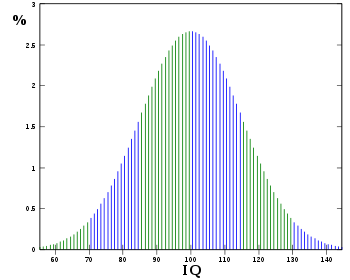
One of the most misunderstand issues is the rating of 100 as average. This average is determined from all the people of an age category that take the test and not an actual score. The average person does not get 100 points on the exam. All the exams taken are averaged and this average is assigned the value of 100. The actual score of the exams has been going up by about three IQ points per decade. This is was first noticed in an important and controversial book called The Bell Curve. I’m going to be talking much more about that book later in the week.

Age is an important factor in the IQ test and peak performance occurs at 26 after which it’s all down hill. Don’t I know it. From my point of view, this in itself indicates a problem with the testing. I’ll get to that later in the week.

The next factor is something called the Standard Deviation which is set at 15 points. The math is interesting and worth a perusal but the main issue is that 95% percent of people who take the test fall within two SDs or 70 to 130 on the test. Hence, people who score better than 146 – 149 are in the top .1% and considered genius although the test itself does not use such terminology.

What is indisputable is that IQ tests, as given, are excellent predictors of accomplishment in life. People with higher IQ rankings go further in school, get better jobs, make more money, and general succeed more than people with lower IQ scores.

All IQ tests, and there are many, use something called a g-factor. It gets fairly complicated here but the base idea is that there are some general ways in which smart people excel over less smart ones and by testing these g-factors we can establish a baseline of intelligence. For example, smart people generally do better in all subjects than those less smart. If intelligence was subject based then we would expect to see people smart in one subject and dumb in others. While it is true that people excel in one area more than others it is normal for the smart person to get better grades in all subjects than the less smart person.

Another extraordinarily interesting factor is that people who do well on IQ tests tend to be the parents of people who do well on IQ tests and the same correlation, in reverse, occurs for people who do poorly on tests. This is one of the main points of The Bell Curve. We want smarter people because they will succeed more and the world will be better.

The issue is largely a question of whether or not the test is accurate. I think we can all agree that someone my size, 5′ 7″ 160 lbs of twisted steel, is not going to be playing offensive tackle for the St. Louis Rams. So, physical differences in people is an accepted fact. Mental differences, not so much. We imagine that all people have an equal ability to think but if this is wrong, if there are inherent, genetic inequalities in intelligence should we not try to take advantage of them? And, if these factors are inheritable from generation to generation can we as a society forge better people? Frightened yet?

And you thought this was going to be boring, didn’t you?

Until tomorrow,

Tom Liberman
Sword and Sorcery fantasy with a Libertarian Twist

Stupid in the News

young and stupidI find myself rolling my eyes yet again as people call each other stupid. It was pretty much the national sport of Democrats when Yale and Harvard business school graduate George W. Bush was president. Now, in a peevish reminder of how we behaved as children, is seems necessary for Republicans to refer to Columbia University and Magna Cum Laude Harvard Law School graduate Barack Obama in the same fashion.

I suppose I must have a different opinion of “stupid” than apparently everyone else in the United States. By the way, I dropped out of the University of Idaho. It seems reasonable to guess that perhaps I’m the stupid one and everyone else is right. But I know better, you idiots! 🙂

Today I’m going to examine the phenomenon of calling people stupid but all next week I’m going to try to define intelligence. It’s a tricky topic but worth an investigation. However, let’s move on to today’s topic: Why we call people stupid when they are objectively intelligent.

When we criticize someone’s intelligence we are basically suggesting that everything they say is likely to be false. It’s much easier to say someone is stupid than it is to examine their words and ideas. Politicians talk … a lot. And when you talk a lot there is inevitably some stupidity that is going to slip out. A lot of times the “stupidity” is merely jumbling word order or getting two facts confused with each other. Sometimes we speak before we’ve completely thought through an argument and say things that later prove inaccurate. It’s normal. We all do it.

However, sometimes we just say stupid things in the heat of the moment. It doesn’t mean we’re stupid, or the political candidate for the other side is stupid. It means we said something stupid. The more we talk, and again politicians talk a lot, the more likely it is that stupid things are going to slip out. Perhaps we need to establish some sort of ratio of stupidity to non-stupidity. I don’t know, I’ll talk about it more later in the week.

The point I’m trying to make here is to not believe that someone is stupid just because you disagree with them. Listen to what they have to say each time they speak and judge that idea on its merits, not on some preconceived notion of the intelligence of the speaker. This is particular true in politics. It is important because the members of both parties have good ideas but the “all or nothing” philosophy that seems to pervade the United States is unhelpful in actually solving issues. We, with our votes, send men and women to Washington D.C. with the sole goal of destroying the other party and without much thought to making the country better.

So, the next time your friend calls President Bush or President Obama stupid I want you to look them in the eye and say, “I actually think [Bush/Obama] is an intelligent man. I disagree with him [sometimes/frequently/usually] but that doesn’t make him stupid.”

It’s up to us voters to change this country and calling each other names didn’t work in 3rd grade and it’s not going to work now.

[polldaddy poll=6119010]

Tom Liberman
Sword and Sorcery fantasy with a Libertarian Twist

Windows 8 (Metro) Developed on Mac – CTF

Windows on MacMaking the rounds lately all over Facebook, Twitter, and everywhere else is the “fact” that the new Windows Operating System from Microsoft, Metro, was developed on a Macintosh computer. If you do a search on the internet this “fact” is everywhere.

Here’s the real scoop but I’ll sum it up for you and then you tell me if the people passing around the Mac article are guilty of Critical Thinking Failure.

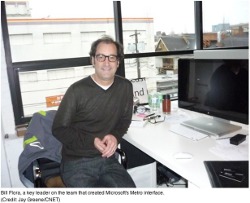
A fellow named Bill Flora worked at Microsoft and was one of the key developers in Windows 8. About a year ago he moved on from this position and started his own company. With Windows Metro being released soon he was the subject of an interview by CNET. In the interview a current picture of him with a Mac computer on his desk ran with the story. Thus, to Apple fans everywhere, Windows 8 was developed on a Mac. Naturally Flora laughs when he hears this bit of nonsense.

Anyway, you tell me, was it a Critical Thinking Fail to pass along this story?

[polldaddy poll=6118593]

Tom Liberman
Sword and Sorcery fantasy with a Libertarian Twist

Critical Thinking

Critical THinkingI spend a lot of time in my various blogs talking about using my Critical Thinking skills to analyze a situation but I realized that I haven’t really defined the concept. So, today I am to rectify that issue.

Critical thinking is a process of thinking that questions assumption. Basically, instead of assuming something is true it is often best to examine the assumption with an eye towards facts. It’s pretty easy to hear something that you believe in general principle and immediately take it as fact without examination.

Often when I get into discussions with friends and families they make a statement that turns out to be untrue. I don’t think they are lying. I think, largely, they heard something they wanted to be true and therefore didn’t examine it critically but simply repeated it.  This is particularly dangerous because other people told this “fact” then repeat it down the line. This can be an incredibly powerful form of propaganda.

As a quick example, when President Bush began to mention Iraq and the September 11 attacks together people immediately began to believe that Iraq and Saddam Hussein were behind the terrorist activity. How many of you repeated this lie?

More recently I’ve had several friends say that six witnesses corroborate George Zimmerman’s story in the Trayvon Martin slaying. This is also false. Have you repeated it?

My point isn’t that you’ve made mistakes because I’ve certainly made many myself. My point is that it is important to examine propositions from a Critical Thinking point of view.

Critical thinking comes from something called the Socratic Method. This is the examination of an idea through questions. It basically involves doing the following when presented with an idea:

  • Recognize problems, to find workable means for meeting those problems
  • Understand the importance of prioritization and order of precedence in problem solving
  • Gather and marshal pertinent (relevant) information
  • Recognize unstated assumptions and values
  • Comprehend and use language with accuracy, clarity, and discernment
  • Interpret data, to appraise evidence and evaluate arguments
  • Recognize the existence (or non-existence) of logical relationships between propositions
  • Draw warranted conclusions and generalizations
  • Put to test the conclusions and generalizations at which one arrives
  • Reconstruct one’s patterns of beliefs on the basis of wider experience
  • Render accurate judgments about specific things and qualities in everyday life

This is a tough list to parse but it basically is the idea that you should always demand evidence. Just because something sounds true is not good enough. This is where it is diametrically opposed to Faith Based Thinking which demands no evidence. In Faith Based Thinking we do not question, we simply assume truth without evidence.

What I find particularly fascinating is that most people engage in critical thinking when it comes to home decisions, work decisions, and shopping decisions. We go to great lengths to make sure the decisions we make about our life are correct by looking at all the facts, examining multiple ideas, researching online, and otherwise avoiding bad decisions.

Conversely, it seems almost a given that in regards to social issues, political issues, and religious issues that Faith Based Thinking dominates. If a politician of the party I identify with says something then I immediately turn off my brain and support it. If someone from a group that I don’t normally agree with says something I immediately disagree without any examination.

I would suggest that we should put as much effort into making political and social decisions as we do to that next major purchase. That is if we want to make an accurate decision. If we want to be wrong a lot then continue to simply take whatever the politicians from your party say at face value.

So, there it is. Critical Thinking. I’ll probably revisit this topic using a real-world example soon.

Tom Liberman
Sword and Sorcery fantasy with a Libertarian Twist

Human Caused Climate Change – Conclusions

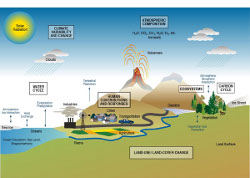
Climate ChangeToday I take an actual position. I’ve waited all week and tried to examine the various issues of human driven climate change from a critical thinking perspective. I think the evidence goes both ways to some extent but, by and large, the model that resonates with me is the idea of a bathtub filling with water.

Non-human, “natural causes”, pour huge amounts of CO2 into the environment but in response non-human forces pull it out of the system. These “sources” and “sinks” largely balance one another although catastrophic events in history, super volcanos and meteor strikes, have sent them disastrously out of equilibrium for tens of thousands of years or longer. Naturally it is impossible to always say why there was an imbalance but it seems fairly obvious to me that a preponderance of CO2 in the atmosphere bodes ill for life on the planet.

So, we have a bathtub filling with CO2 from the spigot at a rate of X and emptying from the drain at a rate of Y. Human activity is both increasing X and decreasing Y albeit by a small percent of the total. Still, a 1% change at both ends is going to eventually result in the tub overflowing.

It is always going to be impossible to say for certain that the small human effect on CO2 is solely, partially, or not at all responsible for the corresponding rise in CO2 content in the atmosphere and there will be always be reasonable arguments that other forces are in play. It is also impossible to prove that CO2 amounts in greater quantities is solely or partially responsible for climate change.

That being the case I really don’t understand the argument that we shouldn’t make an attempt to stop our flow of CO2 into the atmosphere. I’m not suggesting that we immediately turn off the coal-fired powerplants or stop using the oil infrastructure that is currently in place. But, it seems wise to hedge the bets a little. If we can cut down on the various things we do that release CO2 into the atmosphere and it’s not catastrophically expensive, why not do it?

One important thing I’ve noticed is that we are, in fact, doing it. People are making purchases with a cleaner environment in mind. Large companies, huge companies, like Wal-Mart change their truck fleets to be green and this has a large impact on the problem. This is capitalism and free thought. In China, where much of the CO2 is produced, they are making huge strides in increased green technology.

Europe leads the world in development in solar and wind energy. The United States wind farms are massive and growing better everyday. I see little windmills all over St. Louis now. This is capitalism in action. There are companies out there trying new things because they realize that whomever comes up with clean and cheap energy solutions will make a ton of money! What is amazing is that these things are happening with relatively minor government interference. We still continue to give subsidies to the oil industry and tax breaks to people who purchase large vehicles for work. Yet, companies and individuals are lining up to purchase green technology. President Obama has initiated a green initiative which is, I suppose, fine as a counter to the oil initiatives but I’d just like to see government get completely out of the tax break business, oil, green, whatever.

The idea here is that government agencies are trying to steer technology towards an end or towards the company that pays for their campaigns. If we just let capitalism do its job then we’ll get a green world. Meanwhile, I see my friends, be they Libertarian, Democrat, Republican, non-voter, buying vegetables they think are healthy and light bulbs that last longer. Make a better product and you will succeed. And, it’s hard for me to imagine anyone who has worked with the filth that is oil, arguing that green energies are not objectively better. Currently more expensive, yes, but worse? In time, as technology continues to improve and buying habits continue to change, this problem will be solved.

Who knows, someone may come up with a way to scrub CO2 from the atmosphere.

Anyway, that’s my final take on it. We have largely recognized the problem and solutions are being attempted. It’s a complex issue, there are a number of solutions available, the practical ones are being used, the impractical investigated, technology explored. Why all the hate?

Tell me what you think in the comments and share away!

Tom Liberman
Sword and Sorcery fantasy with a Libertarian Twist